
Author's details
- Dr Bashir Taiye Aminu.
- MBBS (Ilorin) FWACP (Int. Med./Pulmunology) MHE (BUK) Cert LMIH and FGHR (Washington) IR (Malaysia/UNU) ECFMG-EPIC Certified Physician
Reviewer's details
- Dr Jafaru Momodu
- MBBS, ACP Member, Member NPGMCN, FWACP Pulmonology.
- National Hospital Abuja. Researcher.
- Date Uploaded: 2026-03-07
- Date Updated: 2026-03-07
Asthma
Key Messages
- Asthma is a chronic inflammatory airway disease marked by variable airflow obstruction and hyperresponsiveness.
- It is common in Nigeria and often underdiagnosed or poorly treated due to limited resources and misconceptions about inhalers.
- Typical symptoms include wheeze, breathlessness, chest tightness, and cough that vary with triggers and time.
- Diagnosis relies on spirometry, peak flow variability, FeNO, and allergy testing; though access is limited in many African settings.
- Proper management follows a stepwise approach with inhaled therapies, patient education, trigger avoidance, and regular follow-up.
Asthma is a chronic inflammatory disorder of the airways characterized by variable airflow obstruction and bronchial hyperresponsiveness. The pathophysiology involves Th2-mediated inflammation with eosinophils, mast cells, and cytokines (IL-4, IL-5, IL-13), leading to airway remodelling, mucus hypersecretion, and smooth muscle hypertrophy. Globally, it affects 1-18% of populations, with increasing prevalence in urbanizing regions of Africa.
Local Context: Nigeria shows significant asthma burden, with prevalence ranging 4.5-13% in various studies, often underdiagnosed and undertreated due to limited resources and cultural beliefs about inhaler therapy. (Olufemi et al., 2018; Nigerian Medical Journal)
Symptoms & Clinical Features
- Recurrent episodes of wheezing, breathlessness, chest tightness, and cough (often worse at night/early morning). Symptoms are usually of variable intensity and intermittent.
- Symptoms vary seasonally or with triggers (exercise, allergens, infections)
- Features of allergy may be present especially in those with allergy-predominant asthma.
- Nigerian specific: High rates of aspirin-exacerbated respiratory disease reported; frequent exacerbations during harmattan (dry, dusty season) (Adeyeye et al., 2021; African Journal of Respiratory Medicine)
- Clinical signs: Expiratory wheezing, increased respiratory rate, prolonged expiratory phase, use of accessory muscles during exacerbations. Depending on the degree of exacerbation, the patient may be cyanosed with low oxygen saturation, diaphoretic, with silent chest in case of life-threatening attack.
Differential Diagnosis
- COPD (particularly asthma-COPD overlap)
- Vocal cord dysfunction: wheeze is at the level of the vocal cord and not responsive to inhalers and known asthma therapies. May co-exist with asthma.
- Gastroesophageal reflux disease: presenting as “difficult to treat asthma”, particular with disturbing dry cough, sensation of acid brash in the mouth. Presenting mostly during sleep and commoner in obese individuals
- Bronchiectasis: recurrent chest infection leading to irreversible airway damage and dilation.
- Heart failure (cardiac asthma): acute left ventricular heart failure presenting with cough of frothy-pinkish sputum with wheeze
- Foreign body aspiration (especially in children): particular causing large airway obstruction.
Investigations
- Spirometry: Reversible airflow obstruction (≥12% and 200mL increase in FEV₁ post-bronchodilator)
- Peak Expiratory Flow: Variability >20% between measurements
- FeNO: Elevated fractional exhaled nitric oxide (>50 ppb suggests eosinophilic inflammation)
- Allergy testing: Skin prick tests or specific IgE
- Chest X-ray: Typically, normal but rules out other pathology especially pneumothorax, heart failure and chest infections among others
African context: Limited access to spirometry in primary care; reliance on clinical diagnosis common (Binegdie et al., 2015; Pan African Medical Journal)
Treatment
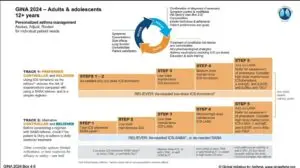
Stepwise approach (GINA 2024 guidelines):
- Step 1: As-needed low-dose ICS-formoterol for mild asthma
- Step 2-5: Regular maintenance therapy with ICS-LABA combinations
- Acute exacerbations: Systemic corticosteroids, oxygen, nebulized SABA
- Nigerian adaptation: Challenges with inhaler affordability; increasing use of locally produced MDI spacers from plastic bottles (Desalu et al., 2019; Nigerian Journal of Clinical Practice)
Follow-up
- Every 3-6 months for stable patients, monthly for poorly controlled disease.
- Assess symptom control (ACT questionnaire), asthma action plan, inhaler technique, adherence
- Review environmental trigger avoidance
Prevention & Control
- Identification and avoidance of triggers (dust mites, cockroaches in humid climates)
- Education on inhaler technique (demonstrate-return-demonstrate method)
- Influenza and pneumococcal vaccination
- Community programs: "Asthma Friendly Schools" initiatives in Lagos showing promise (Fadare & Ojo, 2020)
Conclusion and Experience from the clinic
Asthma management in Nigeria requires culturally adapted education, improved access to diagnostics, and affordable inhaled medications. Integration of asthma care into primary health systems is crucial for reducing morbidity.
Majority of the patients with asthma are diagnosed clinically, some correctly while others were wrongly pronounced. In most cases, the initial points of contact either place the patients on SABA only, or with oral steroids and some antihistamines. Such patients usually present with uncontrolled disease with profound side-effects of the wrong regimen. When not sure or in doubt, always refer your patient to a specialist for proper evaluation including spirometry, guidance on appropriate inhalers and techniques, so as use of asthma action plan.

A 28-year-old woman presents with recurrent episodes of wheezing, chest tightness, and night-time cough that worsen during the harmattan season. She reports frequent use of a borrowed SABA inhaler with little relief. Examination reveals expiratory wheeze and prolonged expiration. Limited access to spirometry leads to a clinical diagnosis of asthma, and she is started on low-dose ICS-formoterol with education on inhaler technique and trigger avoidance.
- Desalu OO, et al. (2019). Improving asthma care in Nigeria: the challenges and opportunities. Nigerian Journal of Clinical Practice.
- Olufemi O, et al. (2018). Prevalence of asthma symptoms in adolescents in Lagos, Nigeria. Nigerian Medical Journal.
- Binegdie AB, et al. (2015). Asthma care in sub-Saharan Africa: current practice and future perspectives. Pan African Medical Journal.
- Global Initiative for Asthma (GINA). (2024). Global Strategy for Asthma Management and Prevention.
More topics to explore
Author's details
Reviewer's details
Asthma
- Background
- Symptoms
- Clinical findings
- Differential diagnosis
- Investigations
- Treatment
- Follow-up
- Prevention and control
- Further readings
Asthma is a chronic inflammatory disorder of the airways characterized by variable airflow obstruction and bronchial hyperresponsiveness. The pathophysiology involves Th2-mediated inflammation with eosinophils, mast cells, and cytokines (IL-4, IL-5, IL-13), leading to airway remodelling, mucus hypersecretion, and smooth muscle hypertrophy. Globally, it affects 1-18% of populations, with increasing prevalence in urbanizing regions of Africa.
Local Context: Nigeria shows significant asthma burden, with prevalence ranging 4.5-13% in various studies, often underdiagnosed and undertreated due to limited resources and cultural beliefs about inhaler therapy. (Olufemi et al., 2018; Nigerian Medical Journal)
- Desalu OO, et al. (2019). Improving asthma care in Nigeria: the challenges and opportunities. Nigerian Journal of Clinical Practice.
- Olufemi O, et al. (2018). Prevalence of asthma symptoms in adolescents in Lagos, Nigeria. Nigerian Medical Journal.
- Binegdie AB, et al. (2015). Asthma care in sub-Saharan Africa: current practice and future perspectives. Pan African Medical Journal.
- Global Initiative for Asthma (GINA). (2024). Global Strategy for Asthma Management and Prevention.
Content
Author's details
Reviewer's details
Asthma
Background
Asthma is a chronic inflammatory disorder of the airways characterized by variable airflow obstruction and bronchial hyperresponsiveness. The pathophysiology involves Th2-mediated inflammation with eosinophils, mast cells, and cytokines (IL-4, IL-5, IL-13), leading to airway remodelling, mucus hypersecretion, and smooth muscle hypertrophy. Globally, it affects 1-18% of populations, with increasing prevalence in urbanizing regions of Africa.
Local Context: Nigeria shows significant asthma burden, with prevalence ranging 4.5-13% in various studies, often underdiagnosed and undertreated due to limited resources and cultural beliefs about inhaler therapy. (Olufemi et al., 2018; Nigerian Medical Journal)
Further readings
- Desalu OO, et al. (2019). Improving asthma care in Nigeria: the challenges and opportunities. Nigerian Journal of Clinical Practice.
- Olufemi O, et al. (2018). Prevalence of asthma symptoms in adolescents in Lagos, Nigeria. Nigerian Medical Journal.
- Binegdie AB, et al. (2015). Asthma care in sub-Saharan Africa: current practice and future perspectives. Pan African Medical Journal.
- Global Initiative for Asthma (GINA). (2024). Global Strategy for Asthma Management and Prevention.
Advertisement